Robotic Workforce Integration: The Discipline Organizations Need, But Haven’t Built Yet
Automation is advancing faster than organizations can absorb it. This manifesto defines robotic workforce integration as the discipline that keeps people, culture, and governance at the center of robotics adoption.
Introduction: Automation Is Advancing Faster Than Organizations Can Absorb It
Across industries, robotics is no longer a future consideration. It is a current operational decision. Manufacturing floors are adopting collaborative robots. Research facilities are automating repeatable tasks. Hospitals and logistics operations are integrating service and mobility platforms. Even sectors once insulated from automation are now evaluating robotic support roles.
Yet one pattern has become unmistakable: the technology is maturing far faster than the organizational frameworks required to integrate it.
Most companies can acquire robotics.
Very few can integrate robotics without destabilizing their people.
The consequence is not simply slower ROI. It is cultural disruption, workforce anxiety, HR overload, and board-level concern about reputation and safety. These are not technical failures. They are organizational failures — failures caused by the absence of a discipline built specifically for the human side of automation.
This is why robotic workforce integration must exist. It is the missing structure that enables organizations to adopt automation responsibly, coherently, and without cultural collateral damage.
1. What Robotic Workforce Integration Actually Is
Robotic workforce integration is a management discipline focused on preparing people, workforce systems, and leadership structures for the introduction of robotics into real workplaces. It extends far beyond deployment timelines or technical integration plans.
The discipline encompasses:
- How leaders communicate the change
- How workers understand their roles in a new system
- How HR supports transitions and protects culture
- How boards evaluate risk and exposure
- How organizations preserve identity, trust, and operational continuity
In short:
Technical integration installs a robot.
Robotic workforce integration ensures the organization can live with it.
This is not soft work. It is structural work.
2. Why Organizations Need This Discipline Now
2.1 Workers Are Trying to Interpret Change Without Information
In every sector, workers hear about automation long before they encounter it. They see headlines about job loss, platform failures, or dramatic innovation cycles. They hear rumors. They fill in gaps. And in the absence of structured communication, concerns metastasize into resistance.
This is not irrational behavior. It is what people do when they don’t understand their future.
Robotic workforce integration gives leaders a way to provide clarity before speculation takes hold.
2.2 HR and Operations Face Conflicting Pressures
HR protects culture, dignity, and workforce stability.
Operations protects throughput, efficiency, and delivery timelines.
Robotic adoption pulls both functions into new territory, but without a shared framework:
- HR speaks the language of people
- Operations speaks the language of performance
- Both lack a discipline that integrates the two
The result is a reactive posture that erodes trust.
Robotic workforce integration establishes the shared playbook these functions have needed for years.
2.3 Boards Are Approving Automation Without a Full Picture
Most board briefings on automation focus on:
- Cost
- Efficiency
- Vendor capability
- Technical feasibility
What they rarely include is the human exposure:
- Cultural fragmentation
- Labor relations implications
- Safety requirements
- Public and political narratives
- Reputational risk
Boards are becoming increasingly aware of this gap.
Robotic workforce integration closes it.
2.4 Society Now Expects Responsible Adoption, Not Blind Acceleration
Organizations do not operate in a vacuum. They operate in a social ecosystem. As automation expands:
- Workers expect transparency
- Communities expect stability
- Regulators expect responsibility
- Boards expect governance
- Customers expect ethical practice
Robotic workforce integration is the discipline that aligns organizational responsibility with organizational progress.
3. The Core Structure of the Discipline
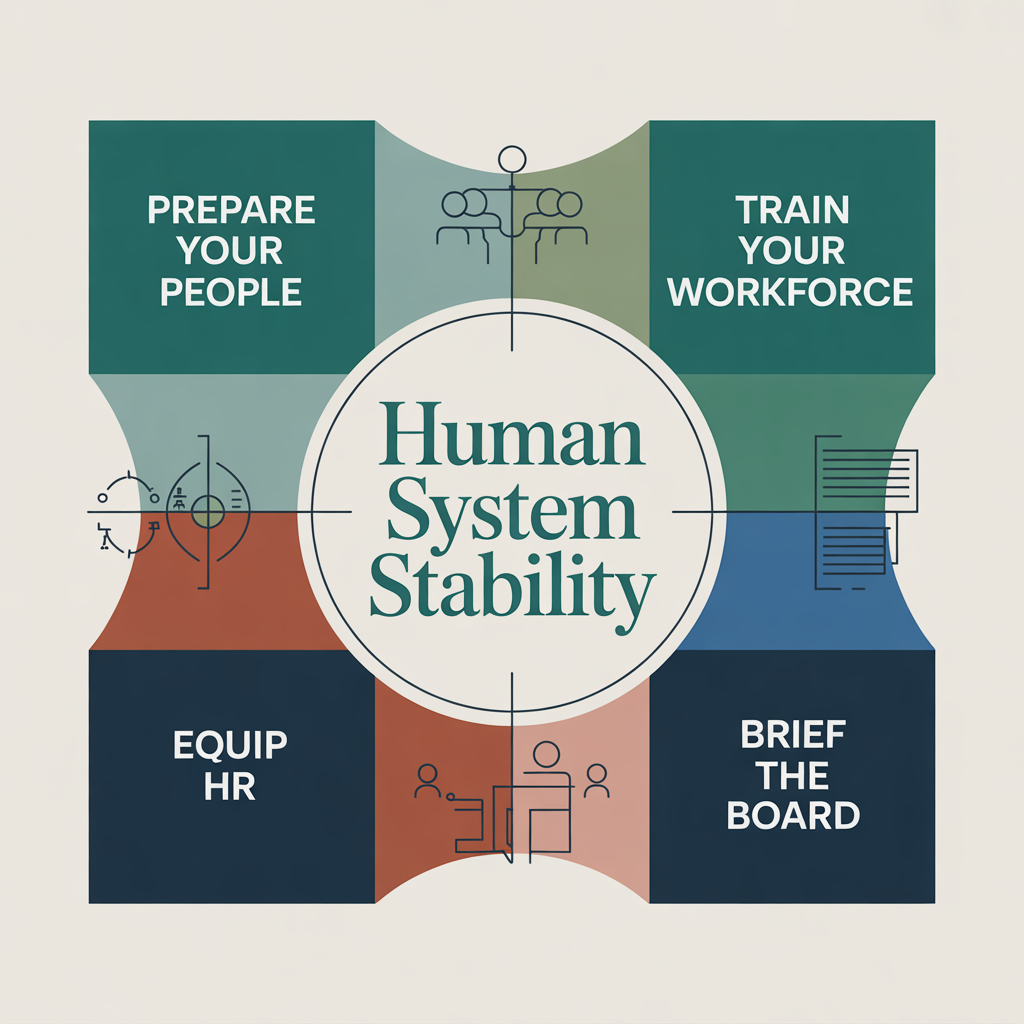
Robot Integration Lab delivers robotic workforce integration through a four-part structure designed to stabilize the human system during automation.
01 — Prepare Your People for Robots
Organizations often underestimate how early anxiety begins. Long before the first robot is purchased, workers start imagining what the change could mean for them.
This element establishes:
- Shared language leaders can use consistently
- Briefings that replace rumor with clarity
- Q&A frameworks that address real human concerns
- Narrative sequencing that lowers fear rather than inflames it
This is the work that prevents cultural fractures before they form.
02 — Train Your Workforce to Work Alongside Robots
A robotic program cannot succeed if people don’t understand their evolving role.
Training includes:
- Role-based skill paths
- Clear task boundaries between human and machine
- Collaboration and safety practices
- On-site support during the transition period
Training is not a technical exercise. It is an identity exercise.
People need to understand not just how to operate a system, but where they still matter.
03 — Equip HR to Lead the Transition
HR becomes the stabilizing force during automation, yet most HR teams are handed responsibility without the tools.
This element gives HR:
- A structured change plan
- Communications sequences grounded in human psychology
- Policy updates for robotic workflows
- Redeployment pathways
- Scenario plans for difficult conversations
- Labor relations guidance
Without this structure, HR is left to absorb shock rather than guide change.
04 — Brief Your Board With Clarity and Confidence
Boards are increasingly aware that automation is a people issue disguised as a technology issue.
This element provides:
- Risk maps that include the human system, not just the technical system
- Scenario planning across workforce and culture
- Governance pathways that protect reputation
- Narrative frameworks for public communication
- Decision points that prevent avoidable exposure
Automation is not simply an operational initiative. It is a governance matter.
4. The Cost of Ignoring This Discipline
When organizations introduce robotics without a structured human framework, the outcomes are predictable:
- Workers assume the worst
- Culture destabilizes under uncertainty
- HR reacts rather than leads
- Training comes too late
- Safety incidents increase during adjustment periods
- Unions escalate concerns
- Boards question leadership’s readiness
- Pilots stall
- Scaling becomes politically or culturally impossible
These are not isolated incidents. They are systemic.
They reflect a missing discipline — not a malfunctioning workforce.
5. Why Robot Integration Lab Established This Discipline
Robot Integration Lab was created after years of observing organizations try to adopt robotics without the structures required to make the transition humane, stable, and credible. Across high-stakes environments — from biomedical research to logistics, manufacturing, and service operations — one pattern repeated:
Robotics didn’t cause instability.
Unpreparedness did.
Executives needed a discipline that treated the human system with the same rigor as the technical system. Workers needed clarity about their future. Boards needed visibility into human risk. HR needed frameworks. Operations needed a partner that understood people as well as process.
No such discipline existed.
So Robot Integration Lab built it.
6. A Responsible Future of Work Depends on a Human Framework
Automation will continue. The question for leaders is not whether robotics will enter their operations, but whether their organizations are ready to absorb it without cultural or reputational loss.
Robotic workforce integration is the discipline that makes responsible adoption possible. It gives leaders structure. It gives HR direction. It gives workers clarity. It gives boards confidence.
Progress does not have to come at the cost of people.
It can come with them — if the organization is prepared.
Robot Integration Lab is proud to define and deliver this discipline for leaders shaping the next chapter of work.
Final Reflection: A Conversation With Micah Viana, Founder of Robot Integration Lab
The following excerpt is from a recent conversation with founder Micah Viana on what organizations keep missing as robotics enters the workforce — and what leaders must do next.
“What executives want,” Micah says, “is clarity.
What HR wants is stability.
What operators want is honesty.
And what boards want is to avoid surprises.”
He pauses before adding:
“Robotics isn’t the destabilizer.
Unstructured change is.”
Micah explains that employees begin forming narratives the moment automation appears on the horizon:
“Silence is a vacuum. Employees fill it instantly — with fear, speculation, and the worst-case versions of their future.
There’s only one antidote: structured communication that gets ahead of anxiety instead of responding to it.”
He emphasizes that robotic workforce integration is organizational discipline, not corporate nicety:
“The companies that win this decade are the ones treating the human system with the same seriousness as the technical one.
If you want automation to work, you must stabilize the people who live with the change.”
When asked what leaders must do first, Micah is unequivocal:
“Start with truth.
Tell your workforce what is coming, what isn’t, and why they still matter.
Robots don’t break culture. Misinformation does.”
He closes with the mandate shaping the next chapter of work:
“Robotic workforce integration is not about machines.
It’s about leadership.
If you get the human layer right, the robots will fit.
If you get it wrong, nothing else will matter.”
Research Brief: Why a Human Framework Is Now Non-Negotiable
Leading institutions across workforce, technology, and organizational psychology are converging on the same conclusion: human readiness determines the success or failure of automation.
Recent studies show:
- 71% of automation failures originate from gaps in communication, culture, and workforce readiness — not technology. (MIT Future of Work Lab)
- 68% of workers report uncertainty about “how their job will change,” regardless of industry. (Pew Research Center)
- Boards cite “human exposure” as their biggest blind spot in automation governance. (Deloitte Global Board Study)
- Companies that implement structured change communication experience 33% higher adoption rates and 40% lower cultural resistance. (McKinsey People & Operations Benchmark)
- HR leaders report that workforce anxiety begins 12–18 months before a robot ever arrives. (Society for Human Resource Management)
These findings validate the core insight that anchors Robot Integration Lab:
Technical integration installs the system.
Human integration makes it sustainable.
When organizations ignore the human system, they repeat a predictable cycle: hesitation → resistance → distrust → stalled pilots → political blowback → scaling failure.
When they build structure around the human transition, productivity, culture, and safety rise together.
This is why the discipline of robotic workforce integration is no longer optional — it is organizational risk governance.
The Industry Standard: Where Leaders Now Align
The organizations at the forefront of automation — from Fortune-scale operations to multi-site manufacturing groups, global HR teams, research labs, and logistics networks — are converging on the same expectation:
Robotics must enter the workforce through a human-first framework.
Executives are demanding it.
Boards are requiring it.
HR is depending on it.
Operators are expecting it.
Communities are watching for it.
This is the standard Robot Integration Lab is defining for the industry:
Robotic Workforce Integration is the discipline that protects the workforce, stabilizes culture, and ensures automation strengthens the organization instead of fracturing it.
This manifesto is not a suggestion.
It is the new norm, the new operating expectation, and the baseline for responsible leadership in the robotic era.
Robot Integration Lab is proud to set this standard — and to guide organizations as they meet it.





Talk to Robot Integration Lab
If you are responsible for humans in a robotic future, this discipline now belongs on your agenda. Tell us where you are in your automation journey and we will respond with next steps and briefing availability.
- You are under pressure to “do something with robots,” but need a plan that won’t destabilize your workforce.
- Your board, HR, or operations leaders are asking different questions about the same automation program.
- You want a human-first framework that can stand up to both public scrutiny and internal reality.
We typically begin with a confidential 90-minute briefing focused on your people, culture, and governance exposure around robotics.
For Journalists & Media
Access the Official Media Briefing Kit on Robotic Workforce Integration
Download the press-ready overview, key facts, and founder biography associated with this article. The kit is available instantly—no email required.


Leave a Reply