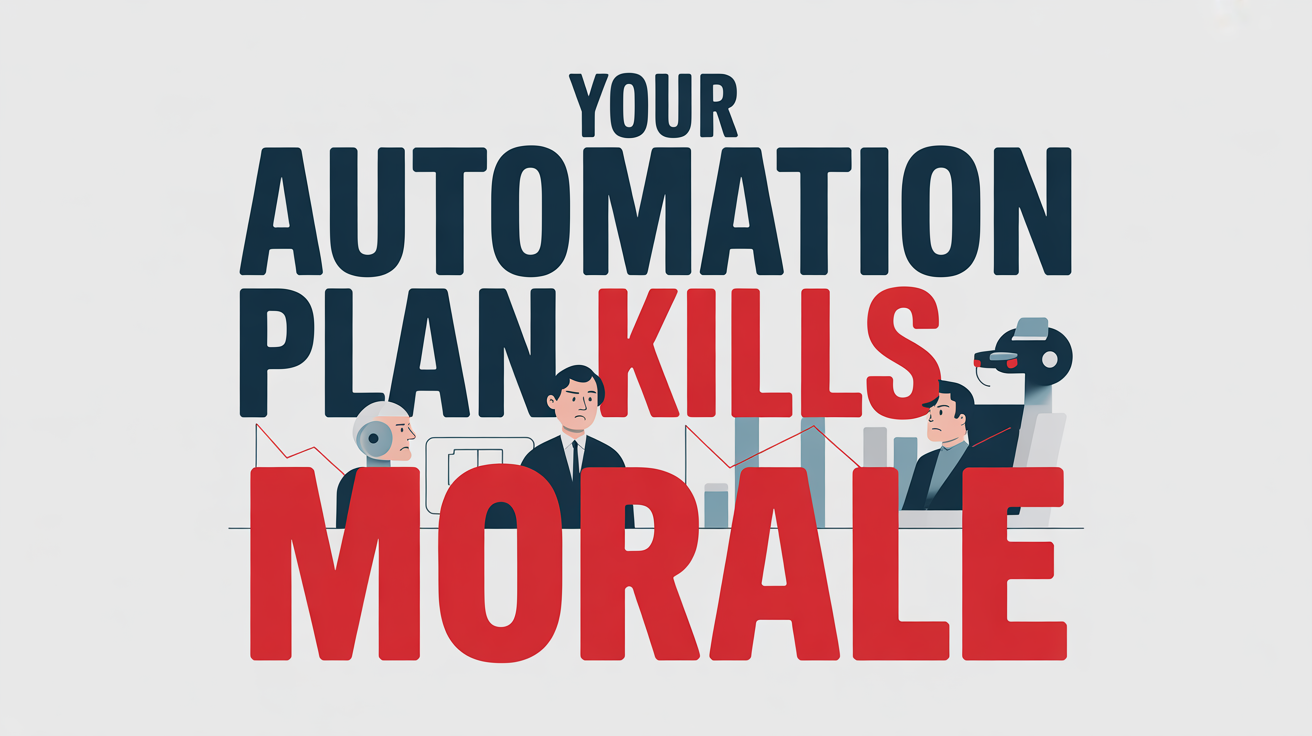
When Pay Stops Feeling Fair During Automation Planning — The Compensation Credibility Risk HR Inherits
Compensation risk rarely starts with payroll. It starts when pay stops feeling defensible.
Automation planning changes what the organization appears to value.
If leaders can’t explain how that new value maps to pay, progression, and incentives, employees don’t assume neutrality.
They assume exposure.
Why This Risk Appears Early
Compensation credibility is a belief system.
It depends on employees being able to answer three basic questions without guessing:
- ■ What will be rewarded as work changes?
- ■ What still counts as high performance?
- ■ Who decides, and by what rules?
Automation planning disrupts all three because job value becomes uncertain before roles are formally redesigned.
This is where credibility cracks:
- ■ pay bands tied to legacy job families feel outdated overnight
- ■ incentives tied to output feel unstable when tasks shift
- ■ “new skills” are celebrated without pay logic attached to them
- ■ managers can’t explain how progression works under transition
No paycheck has to change for legitimacy to weaken.
What Breaks Quietly When Pay Legitimacy Weakens
When compensation feels less fair, behavior becomes narrower.
- ■ extra effort becomes conditional
- ■ learning becomes defensive, not ambitious
- ■ internal movement slows because risk feels personal
- ■ top performers start benchmarking externally
Organizations often misread this as “normal workforce noise.”
It is not noise. It is the first sign that the system no longer feels trustworthy.
Why Leaders Miss It
Leaders usually track compensation through budgets and totals.
Employees track compensation through legitimacy.
- ■ payroll stability does not equal fairness stability
- ■ benefits continuity does not equal progression clarity
- ■ “we’ll address it later” is heard as “we haven’t decided yet”
- ■ HR is expected to answer questions without owning decisions
When answers sound improvised, trust collapses fast.
How Robotic Workforce Integration Governs Compensation Credibility
Robotic Workforce Integration treats compensation credibility as a governance requirement, not an HR messaging task.
Leaders stabilize pay legitimacy by making rules visible while change is still forming.
- ■ define how automation-affected roles will be evaluated during transition
- ■ publish how new skills connect to pay bands and progression criteria
- ■ clarify which incentive structures remain stable and why
- ■ assign decision ownership for compensation changes under robotics adoption
The goal is not reassurance.
The goal is a system employees can understand without guessing.
Executive Questions That Reveal Compensation Risk Early
- ■ Which roles are most likely to be re-valued in the next 12 months?
- ■ Do we have a rule for how automation-related skills affect pay?
- ■ Can managers explain progression without improvising?
- ■ Are incentives still aligned with what we actually want people to do?
- ■ Who owns compensation decisions during the transition period?
If these questions don’t have owners, HR will inherit the damage.
Structured Next Step
-
1 — Robot Integration Readiness Score
Assess governance readiness across role clarity, training capacity, and workforce stability.
→ Take the Readiness Score -
2 — Robot ROI Calculator
Model the hidden cost of disengagement, slower learning, and retention pressure.
→ Run the ROI Calculator -
3 — Lease vs Buy Robots Calculator
Compare models with workforce governance and transition risk made explicit.
→ Use the Lease vs Buy Calculator
Automation changes operations over time. Compensation legitimacy can collapse in a single planning cycle. Govern the rules early — or watch trust drain quietly.
Quando o Salário Para de Parecer Justo na Fase de Automação — o Risco de Credibilidade que o RH Herda
Risco de remuneração raramente começa na folha. Começa quando a remuneração deixa de parecer defensável.
Ao planejar automação, a empresa muda a sensação do que será valorizado.
Se a liderança não explica como esse novo valor se conecta a remuneração, progressão e incentivos, as pessoas não presumem neutralidade.
Elas presumem exposição.
Por que esse risco surge cedo
Credibilidade de remuneração é uma crença.
Ela depende de três respostas simples, sem achismo:
- ■ O que será recompensado quando o trabalho mudar?
- ■ O que ainda define alta performance?
- ■ Quem decide e por quais regras?
Na automação, o “valor do trabalho” fica incerto antes de qualquer redesenho formal de função.
É aqui que a credibilidade racha:
- ■ faixas salariais ligadas a famílias antigas parecem perder sentido
- ■ incentivos ligados a output ficam instáveis quando tarefas mudam
- ■ “novas habilidades” são celebradas sem lógica clara de remuneração
- ■ gestores não conseguem explicar progressão durante a transição
Nenhum salário precisa mudar para a confiança cair.
O que se rompe em silêncio quando a credibilidade cai
- ■ esforço extra vira condição
- ■ aprendizado vira defesa, não ambição
- ■ mobilidade interna desacelera porque o risco parece pessoal
- ■ talentos começam a comparar com o mercado
Isso costuma ser confundido com “ruído normal.”
Não é ruído. É perda de legitimidade.
Por que a liderança não percebe
A liderança mede remuneração por orçamento e total.
As pessoas medem por justiça e previsibilidade.
- ■ folha estável não significa justiça estável
- ■ benefícios iguais não significam progressão clara
- ■ “depois a gente resolve” soa como “ainda não decidimos”
- ■ RH é cobrado por respostas sem ter dono de decisão
Quando as respostas parecem improvisadas, a confiança cai rápido.
Como a Integração da Força de Trabalho Robótica governa credibilidade
A Integração da Força de Trabalho Robótica trata credibilidade de remuneração como governança, não como mensagem.
- ■ definir como funções impactadas serão avaliadas durante a transição
- ■ explicitar como novas habilidades influenciam faixa e progressão
- ■ esclarecer quais incentivos permanecem e por quê
- ■ nomear quem decide mudanças de remuneração durante a adoção
O objetivo não é acalmar.
É criar um sistema compreensível, sem achismo.
Perguntas executivas que revelam risco cedo
- ■ Quais funções podem ser revalorizadas nos próximos 12 meses?
- ■ Existe regra clara ligando habilidade a remuneração?
- ■ Gestores conseguem explicar progressão sem improvisar?
- ■ Incentivos ainda apontam para o comportamento certo?
- ■ Quem é o dono das decisões durante a transição?
Se não há dono, o RH vira amortecedor — e perde credibilidade junto com o sistema.
Seu próximo passo estruturado
-
1 — Robot Integration Readiness Score
Avalie governança, clareza de função e estabilidade da força de trabalho.
→ Calcular o Readiness Score -
2 — Robot ROI Calculator
Modele o custo oculto de engajamento menor e pressão de retenção.
→ Rodar o ROI Calculator -
3 — Lease vs Buy Robots Calculator
Compare modelos com risco de transição e governança explícitos.
→ Usar o Lease vs Buy Calculator
Automação muda a operação com o tempo. A legitimidade da remuneração pode cair em um único ciclo de planejamento. Governe as regras cedo — ou a confiança some em silêncio.




Leave a Reply